
Whispers of Art
Tales, memories, and archival insights. A space dedicated to artworks and the human stories that made them eternal.
Pietro Morgari (Turin, 1852 – London, 1885)
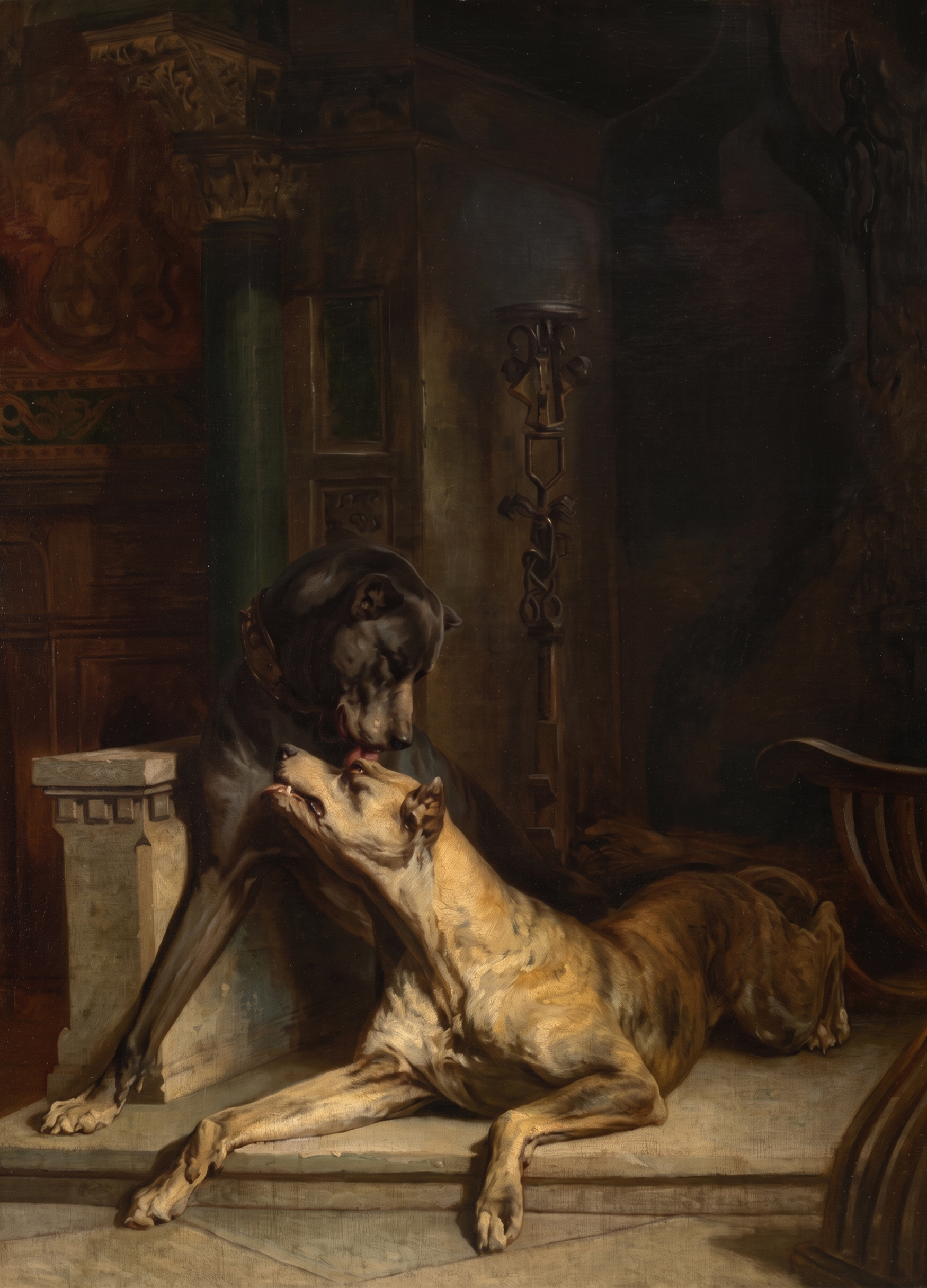
“Idyll (Pluto and Dora)"
Oil on canvas, 92 × 66 cm, c. 1884
Signed upper right
Love for animals: today as yesterday, emotion is bound to existence
They are named Pluto and Dora. Not merely "two dogs," but a couple. The true names of Pietro Morgari’s own pair of dogs.
He, Pluto, keeps watch; she, Dora, rests in trust.
Their muzzles brush without a sound, just enough to convey all that needs to be understood: protection and trust, affection and loyalty.
Pietro Morgari does not invent this tenderness: he recognizes it in life and brings it to the canvas with an almost liturgical reverence. There is nothing cloying here: there is the intake of breath, the heavy settle of paws upon the step, coat gleaming where the light strikes, fur quivering like living silk. The architectural background acts as an austere wing; its sole purpose is to cradle the silence so that the idyll may unfold.
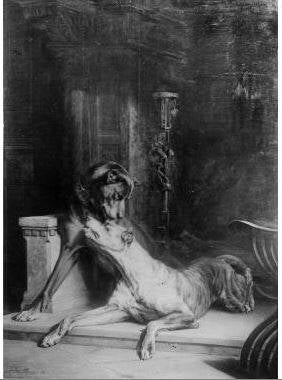
This canvas, contemporaneous and autograph, is an intimate-format version of the Idyll that the painter presented with great acclaim at the Promotrice of Turin in 1884, which subsequently entered the Turin Gallery of Modern Art (GAM), where it is preserved to this day: the same gesture, the same affective cadence, the same shared breaths. Yet the reduced scale of our painting concentrates the emotion, as though the artist wished to hold what he loved with all his strength closer to himself, within reach of a caress.
A canvas imbued with Love:
If one pauses for a moment, it is impossible not to feel them.
Not merely to see them: to feel them.
The darker body, Pluto’s, stands as a bulwark. His paws are firmly set; his chest pressed forward forms a gentle barrier, a protection stripped of all aggression. His head dips just enough to cover the other, as dogs do when they watch over and reassure all at once. His gaze is lowered, his mouth soft: there is no tension, only care.
Dora, honey-tawny in hue, knows what love is. Her outstretched body opens a pale diagonal line; her throat arches upward in a gesture of trusting surrender. It is the movement of one who knows the response before even asking the question. Her relaxed front paws recall that fleeting instant when a dog lets itself fall because it trusts completely.
Between their muzzles lingers nothing but a shadow: a touch, a breath. And through it, everything passes—never to pass away.
One can almost see them move: a lip quivering for a fraction of a second, a wet nose gently touching, a breath shifting its rhythm. Morgari freezes that millisecond in which tenderness turns into form: the step bears their weight, the column provides verticality to the gesture, while the light—measured and warm—falls precisely where the relationship ignites, never to be extinguished.
Pietro Morgari (1852–1885): talent and the wound
“Hero of the Palette,” in the words of Alessandro Stella (1892), Pietro Morgari was born in Turin into a dynasty of painters (Rodolfo was his father, Paolo Emilio his uncle). At the Accademia Albertina he studied under Andrea Gastaldi and Enrico Gamba; he won awards, learned to command movement through draftsmanship, and to master light with audacity. Yet his artistic voice truly caught fire when he chose animals—especially dogs—as his protagonists. Not mere genre props, not just “subjects to paint,” but real presences with names, genuine, cherished, kept by the side of a life that oscillated between joy and despair, happy barks and anxious whines.
Chronicles of the period describe Pietro as “quick of wit, heart, and hand,” modern to the point of restlessness. A real life, his, worthy of a novel. An artist capable of “investigating with acute sensitivity the psychology” of his subjects. These period words still ring remarkably current: Pietro paints with a cool head and a warm heart. Like verses of a deeply felt poem, digging into the depths of absolute fidelity, scratching hopefully at black backgrounds in search of a saving light.
In 1883 he set off for London. There, in Albion, his animal portraits found an audience that understood and felt as he did: purebred dogs, authentic poses, distinct temperaments. The proud nobility of that which—whether human or animal—embodies the very essence of love. Yet his trajectory was tragically cut short: he died by suicide in London in 1885. Fatal was “the passion, a passion of the senses and the mind that strips all measure from the momentum of desire.” A short life, consumed by a personal passion that period criticism never ceased to recount. And there remains the echo of what might have been: a profound imprint on Italian painting, had fate not halted his path.
Pluto and Dora (portrait of a bond)
Calling them by name alters our reading of the work. What emerges is not merely a “theme,” but a true, harmonious, spontaneous relationship within a double love—that between the two dogs, and that between the painter and his dogs—which even today, or perhaps even more so today, engages and disorients, fills with joy or tears, moving anyone who knows what it means to feel sincere affection for their lifelong companions.
Technically, the brushwork is supple and masterful: dry over bony prominence, it softens around the neck, vibrating across short fur; in the blacks there is no abyss, but a living, breathing matter. This is true painting, created by someone who learned—by observing dogs every single day—their temperaments, their postures, their stubbornness. Historical sources record that Pietro Morgari owned purebred dogs and even went so far as to build contraptions to fix their poses: no studio gimmick, but the methodical patience of one who demands that reality mediate with his inner truth.
An “Idyll” that is memory
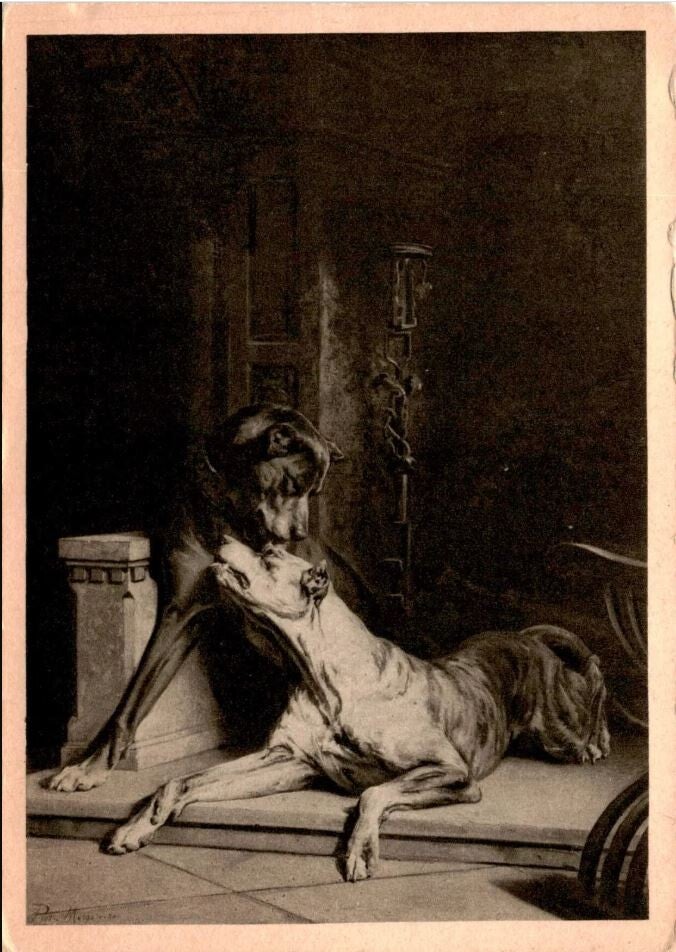
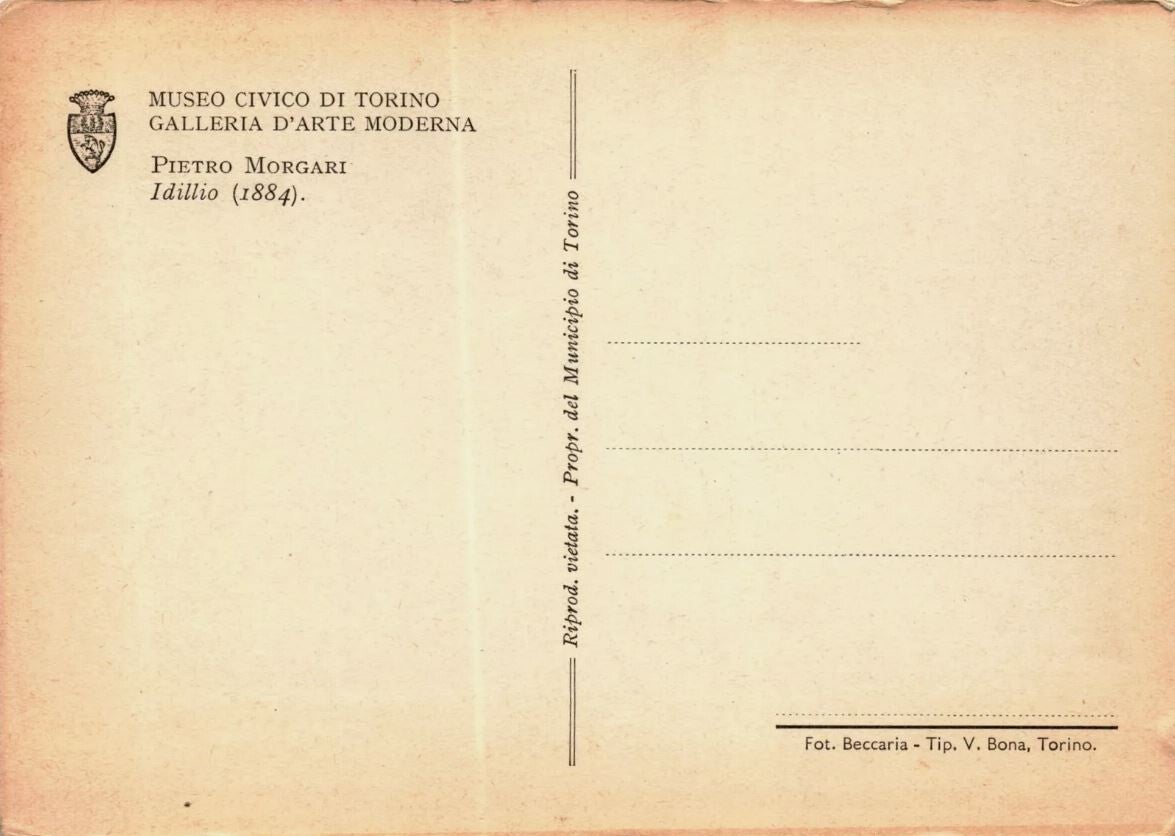
When the large-scale Idyll stepped into the spotlight at the Promotrice in 1884, Piedmontese animalier painting reached an absolute zenith, the very hallmark of Morgari’s artistic identity: animals are portrayed as bourgeois figures endowed with their own dignity, psychology, and presence. In that year, as previously in Violazione di confini (Violation of Borders) and other subjects, Morgari championed an emotional verismo: reality is never cold, for without feeling it remains incomplete. Idyll met with immediate acclaim. Reproduced in period postcards, it was later cited and published in Comanducci.
The contemporaneous variant under consideration possesses the cadence of a private portrait. Same invention, identical touch: blacks built up through layering, amber glazes over tawny areas, dry passages across the joints. Yet the more intimate scale brings everything closer: the viewer stands a mere meter from Pluto and Dora, hearing their breath. It is easy to imagine—and by no means a stretch to do so—that this format was created for himself, as a private keepsake: to capture the object of his love in order to keep loving what he cherished. Not a “picture for others,” but a photograph of the soul, capturing a moment that is both a smile and cool, refreshing water. A glimpse of sky that, even if not the entire heavens, carries within it—when breathed in—the emotion of the instant, the depth of instinct.
Morgari’s soft modernity
Alessandro Stella,iii who knew the painter personally, wrote that Pietro possessed the poetry of movement, and that this very quality led him to dogs: for in them, rhythm is “more genuine, lively, and expansive.” Historic words that sound strikingly modern when looking at Pluto and Dora: movement here is moral before it is physical.
A gesture that chooses the other, and the other choosing the courage to be disarmed, abandoned, before the object of its love. The two dogs are portrayed perhaps a fraction of a second before Pietro calls them to himself, amid caresses and impetuosity, play and complicity, fusing once more gazes and gestures that require no explanation, only to be lived.
Morgari is a true child of nineteenth-century Piedmont, caught between romantic memory and academic discipline. He knows how to combine draftsmanship with warmth. He seeks sharp contrast, warm whites against dark brown shadows, yet never loses tenderness. London welcomed him for this very reason: animal portraits painted as one would paint a household friend, with the exact same gravity accorded to a duke.
Why it still moves us
Because we recognize the gesture. Anyone who has shared a life with a dog knows how rare it is to see them portrayed truthfully: sweetness requires no sugar, nor does loyalty need words to be exalted. Pluto and Dora are not an idea. They are complete realities, offering protection and solace whenever needed; Pluto and Dora embody the craft of a painter who does not betray his heart: a thirty-year-old artist with a sure hand and an expansive future ahead of him, which would instead end early, far too early, in London on an autumn day. Had fate granted him more time, today we would speak of Pietro Morgari as one of the undisputed giants of Italian nineteenth-century art—not only among the animaliers, but among portraitists as well. The quality of his dogs proves it; the portraits we know confirm it. His sensitivity cries it aloud... Pluto and Dora mourn him.
Notes:
1) Pietro Morgari: “Idyll” (1884, Società Promotrice delle Belle Arti) – Archival image
2) Period postcard. Phot. Beccaria – V. Bona Printing House – Turin (front and back)
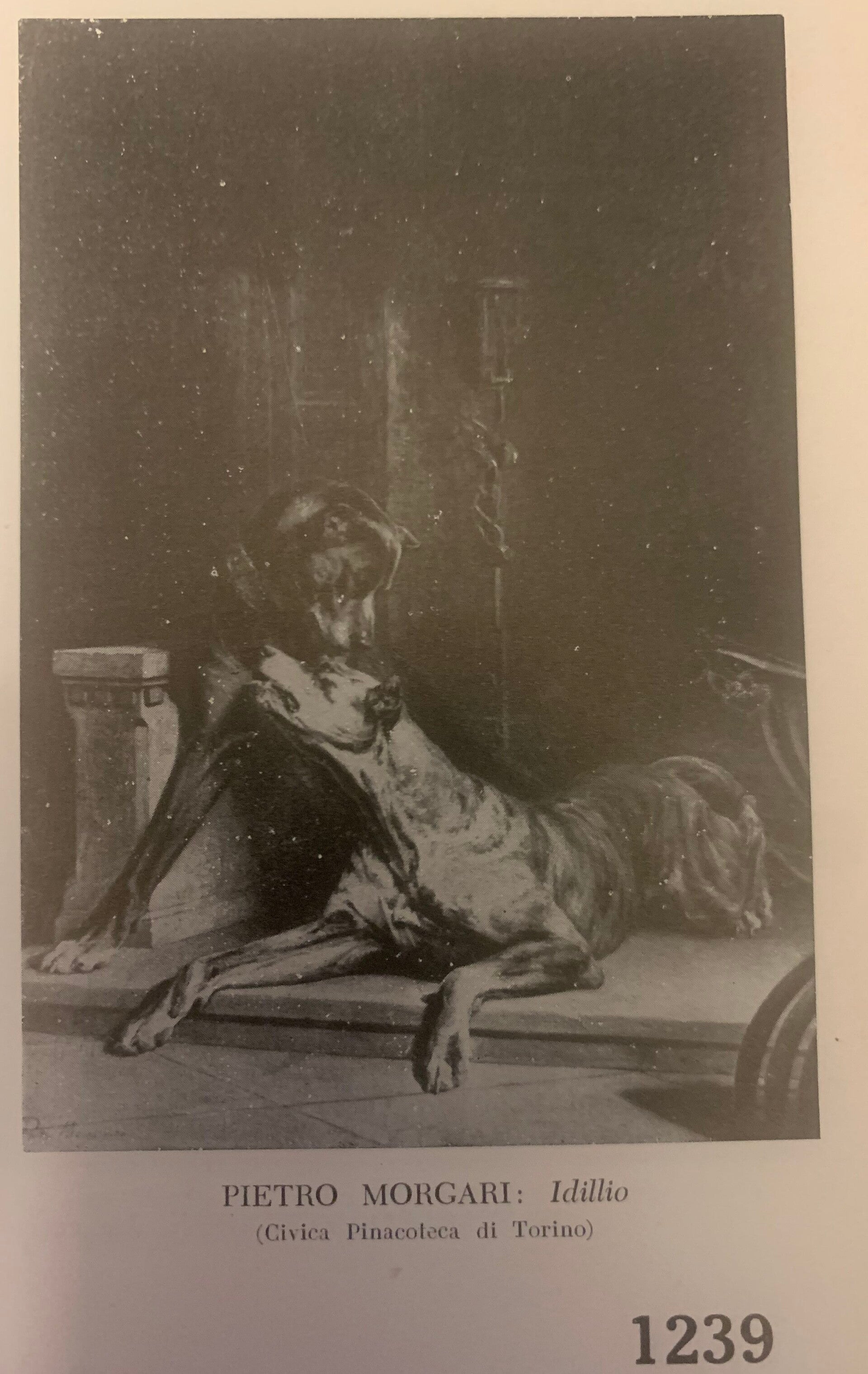
A.M. Comanducci – Illustrated Dictionary of Modern and Contemporary Italian Painters, Draughtsmen and Engravers – Leonilde M. Patuzzi Publisher – Milan 1962 – page 1239