
Tranquillo Cremona (Pavia, 1837 – Milan, 1878)
“Il Sorriso”
("The Smile")
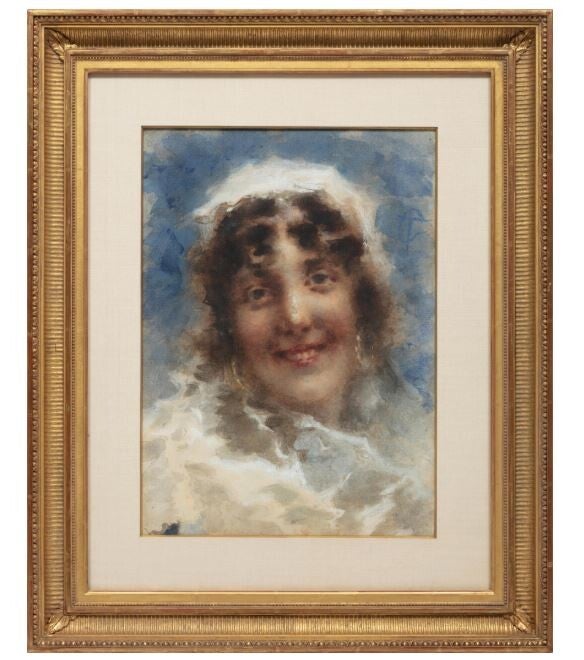
Watercolor on cardboard - 41,9 x 30,5 cm
Monogrammed upper right with the letters "T" superimposed on "C" in blue pigment.
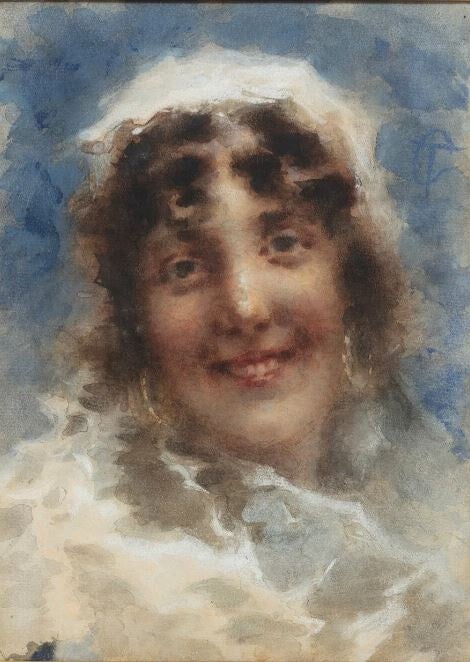
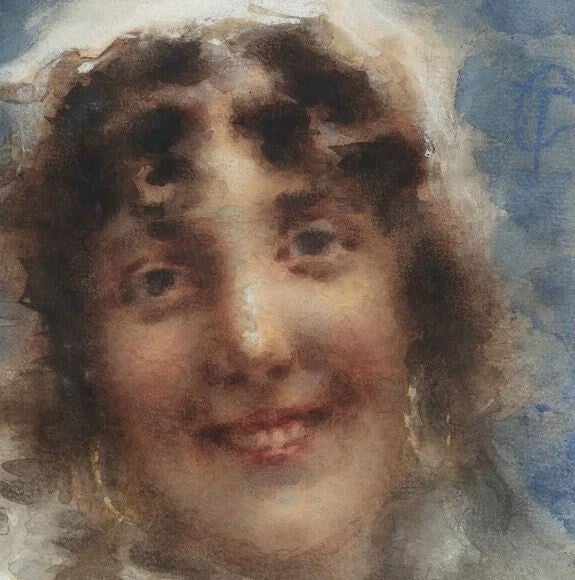
The watercolor Il Sorriso (The Smile, 41.9 x 30.5 cm) by Tranquillo Cremona represents a lyrical synthesis of extraordinary power and an expressive pinnacle of Lombard Scapigliatura. Far from constituting a preparatory study for an oil canvas, the sheet stands as a complete and autonomous "pictorial epigram," in which the Pavia-born artist applies an extreme economy of means to achieve maximum emotional intensity. Executed in the 1870s—the mature period of the movement—the work exemplifies the programmatic value that watercolor held for the Scapigliati painters: a favored medium that, admitting no second thoughts, allowed the artist to capture an impression before the intellect could cool it into closed forms. As Ugo Ojetti noted as early as 1912, Cremona's supremacy lay precisely in the purity of this language, capable of stripping reality of the weight of matter to return it as pure vibration of light and feeling.
Stylistically, Il Sorriso embodies with paradigmatic clarity the aesthetics of the non finito and the dissolution of anatomical contours. Rejecting the academic dogma of Hayezian draftsmanship, Cremona generates the figure from the direct encounter between light and color: the flesh tones do not form a solid surface, but rather a vibrant weave that utilizes the white of the underlying watercolor paper as an internal light source, while the hair and bluish background merge into a vaporous, atmospheric mass. The brushwork, broken and nervous, conceals a refined and deliberate executive sprezzatura which, as critics observed as early as the turn of the twentieth century, anticipated the dynamic perception of reality and the sculptural dematerialization of Medardo Rosso. Sealing the work's authenticity in the upper right corner is the calligraphic monogram with the letter "T" superimposed on "C", rendered in blue pigment: a "floating" graphic mark that dialogues with the cerulean tones of the background and the cold shadows of the face, transforming the signature itself into an element of tonal harmony.
The painting's iconography deliberately shatters the taboos of nineteenth-century academic portraiture, which was traditionally resistant to depicting overt facial expressiveness. Captured in a fleeting and immediate hic et nunc, the sitter embodies the quintessential Cremonian female type: a modern woman whose beauty lies in the mobility of her parting lips and the brightness of her gaze. As biographer Giulio Pisa observed at the end of the nineteenth century, one finds here not the placid divinity of Renaissance Madonnas, but rather a "fresh and mischievous smile" imbued with an intensely immediate sensitivity, suspended between creative euphoria and a melancholic awareness of transience. With this work, Cremona confirms his place as the fundamental link between Romanticism and the future avant-gardes, laying the groundwork for subsequent inquiries into chromatic decomposition that would guide the Divisionism of Angelo Morbelli and the Futurism of Umberto Boccioni.
Further enhancing the art-historical significance of Il Sorriso is its distinguished and fully documented international provenance. Passing through New York at the prestigious Galleria Borghi & Co.—a vital outpost for establishing nineteenth-century Italian painting within the American market—the watercolor subsequently entered the celebrated Collection of Sheldon and Irma Gilgore in Naples, Florida, regarded as one of the most important private holdings of 19th-century Italian art in the United States. The work's scholarly consecration was solidified by its full-page publication (p. 49) in the book and exhibition catalogue Winds of Change: The Milanese Avant-Garde 1860–1900 (2003), edited by internationally renowned scholars Fred Licht and Giovanna Ginex. This historiographical milestone definitively liberated the Scapigliatura phenomenon from any provincial confinement, recognizing in this fragile yet sublime sheet by Tranquillo Cremona a masterpiece of European stature.