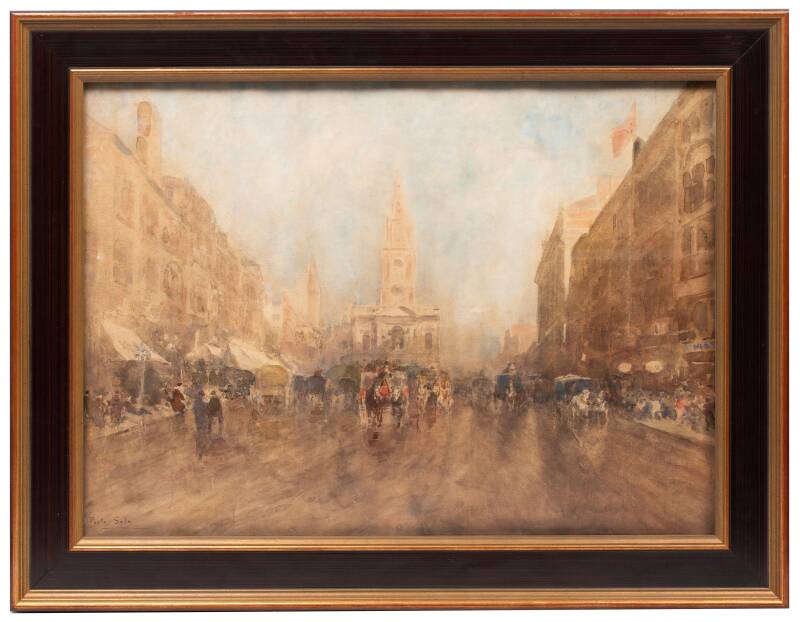

Paolo Sala (Milan, 1859 – Milan, 1924)
“The Strand”
Watercolor on cardboard - 55 x 75 cm
Signed lower left

Executed on an unusually large scale for the medium of watercolor, this sheet depicting The Strand stands out as a significant milestone in Paolo Sala’s production at the turn of the twentieth century. The work moves beyond mere topographical description of the British capital to construct a precise inquiry into metropolitan atmospheres, the stylistic hallmark of an artist with a distinctly international outlook. Within the composition, two facets of Sala’s training clearly coexist: on the one hand, the rigor of his architectural layout—developed at the Brera Academy under Camillo Boito and at the Politecnico di Milano—and on the other, a handling of paint capable of dissolving masonry masses into a damp, Nordic light.
Executed during the artist’s English sojourn, the work belongs to the phase of maturity attained following his travels to Paris, Buenos Aires, and Russia. Having relocated to London in the early twentieth century, Sala engaged with the local watercolor tradition and gained critical acclaim, as documented in 1920 in the pages of The American Magazine of Art, which emphasized his technical confidence in comparison to British masters. The phenomenon of urban fog is resolved through a palette calibrated in tones of gray, ochre, and brown, in which the Lombard sensitivity for the macchia technique and for transparency is integrated with the study of atmospheric effects derived from Turner.
The iconography is centered on the straight expanse of The Strand, a commercial thoroughfare of Edwardian London, dominated at the center by the silhouette of the church of St Mary-le-Strand, designed by James Gibbs. Sala organizes the composition around a central perspective guided by the receding lines of the flanking buildings, juxtaposing the stability of the architecture against the continuous movement of the traffic below. Visually, the painting adopts a rendering that recalls the soft-focus peripheral vision characteristic of period photography: the definition of detail diminishes as one moves away from the focal center of the church, recreating the natural perception of human sight.
Across the street level, the brushwork becomes rapid and summary: vehicles, horses, and passersby are not analytically defined, but conveyed through fields of saturated color that suggest the dynamics of city traffic. The use of watercolor for a sheet of these dimensions reflects a desire to grant autonomy and monumental dignity to a technique often relegated to preparatory studies. The painting thus sits within the line of artistic inquiry that would lead Paolo Sala, in 1911, to found the Associazione degli Acquarellisti Lombardi, furthering the relationship between the structure of drawing and the rendering of impressions studied from life.