
Consalvo Carelli (Naples, 1818 – Naples, 1900)
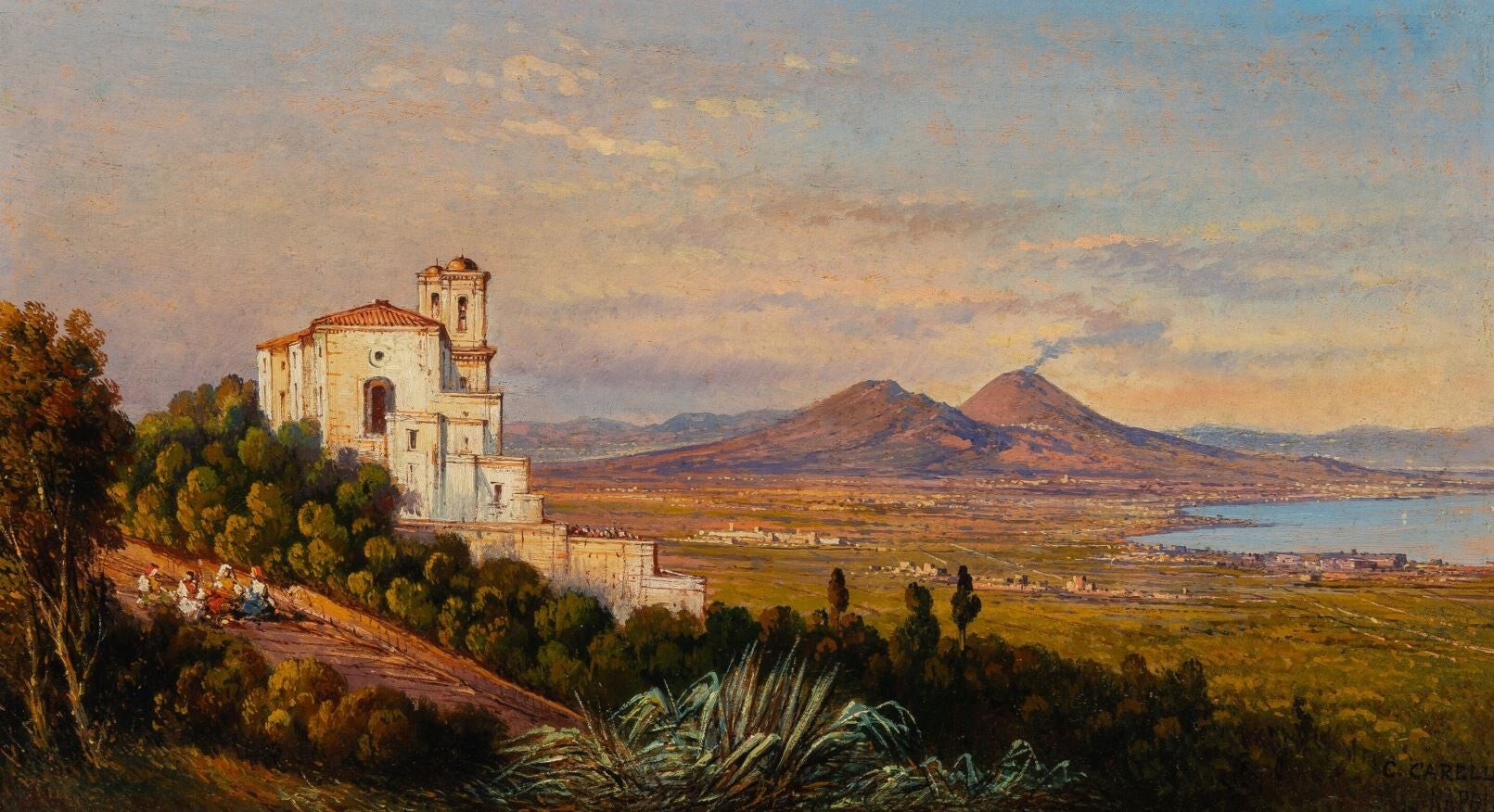
“Il Golfo di Napoli da Santa Maria del Pianto”
("The Gulf of Naples from Santa Maria del Pianto")
Oil on panel - 25 x 45 cm
Signed lower right
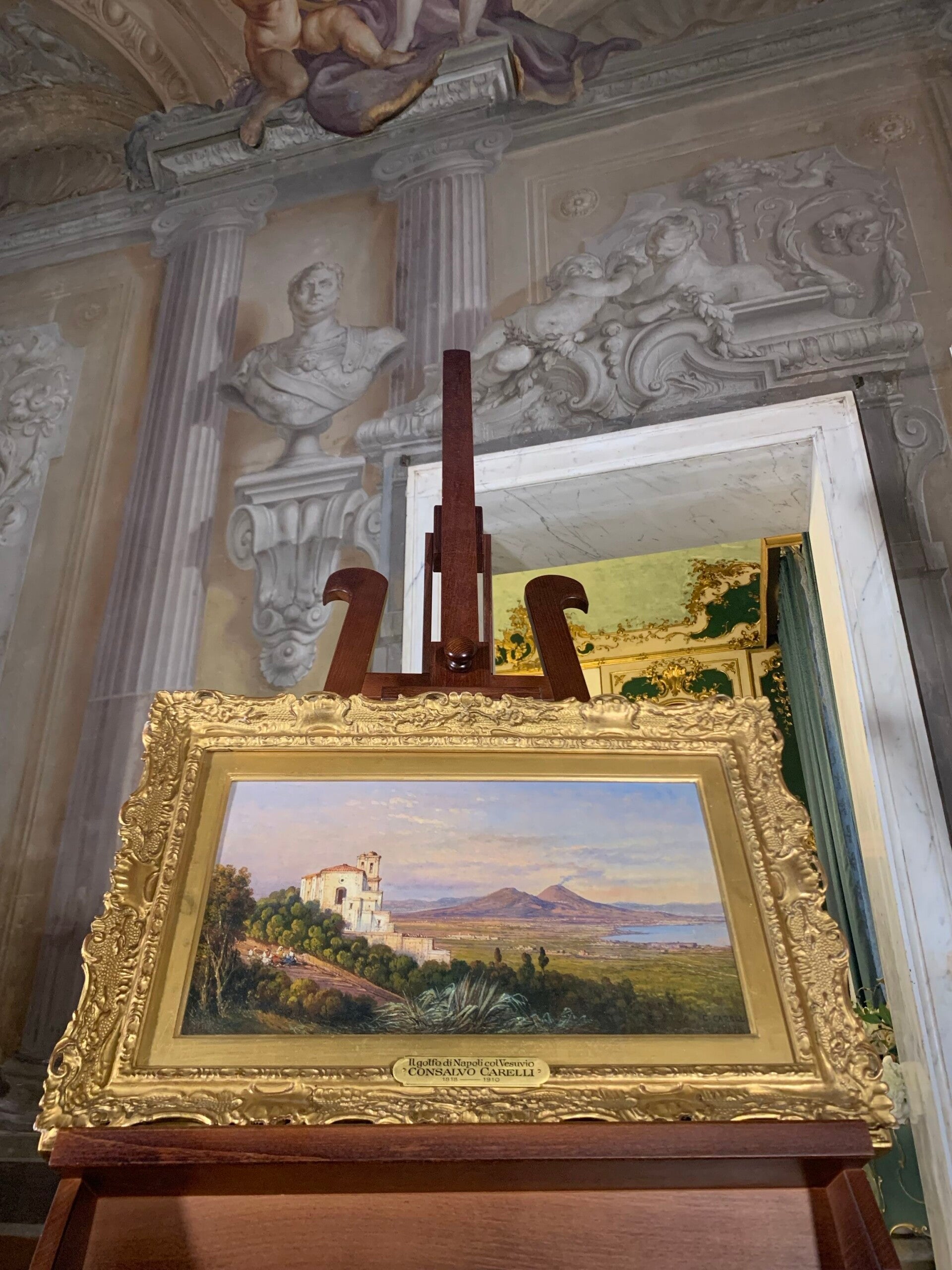
«Santa Maria del Pianto composanto vecchio napoli»: the artist's autograph inscription on the reverse of the panel anchors the composition to a specific site within Neapolitan topography, placing the work firmly within Consalvo Carelli’s mature period. Far from being a mere archival view or a filial repetition of the idiom of the School of Posillipo—initiated by his father Raffaele alongside Anton Sminck van Pitloo—the painting moves beyond analytical description to achieve a deeply personal atmospheric synthesis. While Giacinto Gigante favored an impulsive, summary rendering, and Filippo Palizzi oriented his inquiry toward a verism focused on the everyday, Carelli chose the path of the "Idealized True" («Vero Idealizzato»): a style of painting that preserves topographical accuracy while purging it of accidental flaws, bathed in a clear, tranquil light.
From a technical standpoint, the choice of a panel support directly serves the formal rendering of the work. The gesso ground applied to the wood eliminates the friction characteristic of canvas weave, allowing the brush to lay down pigment into a smooth, compact surface with an enamel-like finish. This technique of Flemish lineage was refined by Carelli during his stay in Paris between 1841 and 1844—culminating in the award of a gold medal at the Salon—and contributed to his acclaim among international collectors, including those connected to Tsar Nicholas I of Russia. Applied in thin glazes, this paint layer allows Carelli to define architectural volumes with precision and to calibrate aerial perspective through subtle chromatic shadows in shades of blue, violet, and pearl gray, rather than relying on academic bitumen.
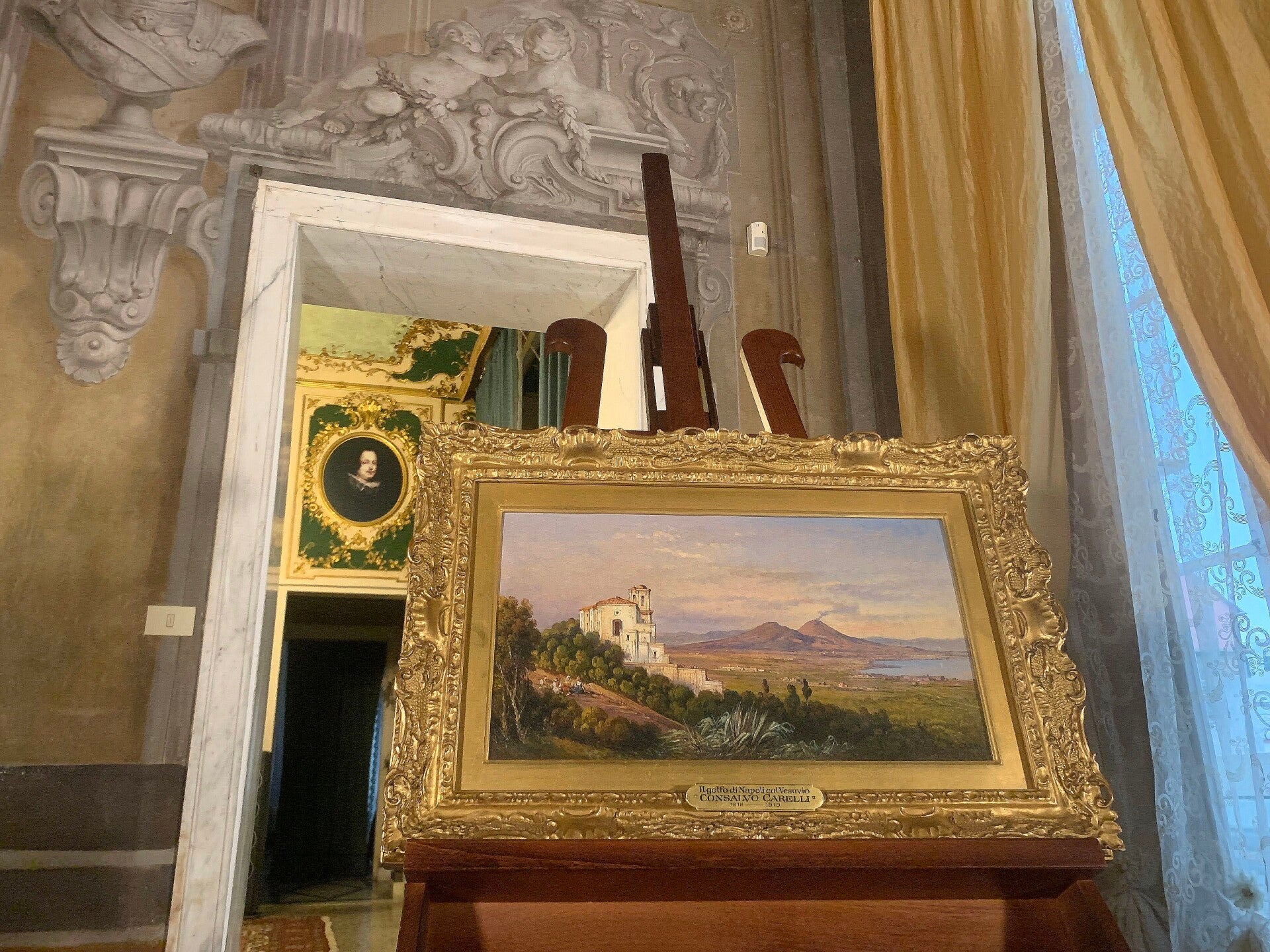
Iconographically, the painting adopts an unusual vantage point compared to the conventions of nineteenth-century vedutismo: rather than looking across the Gulf from West to East (from Posillipo toward Vesuvius), Carelli positions himself on the Poggioreale hill, to the east of the city. The foreground is dominated by the mass of the Church of Santa Maria del Pianto, built above the Grotta degli Sportiglioni—a historic site associated with the plague of 1656—illuminated by the afternoon light. At the foot of the slope lies the Sebeto Plain, evoked in its rural character prior to twentieth-century urban development, while in the background the silhouette of Mount Vesuvius stands out, its plume of smoke dissolving into a sky traversed by light clouds, harmonized in tones ranging from turquoise to champagne.
The articulation of the scene follows a carefully calculated compositional balance. At the bottom, a repoussoir of foliage features a study from life of agaves, rendered in brushstrokes rich in Veronese green that contrast with the sfumato of the plain below. Along the dirt path flanking the wall of the religious complex, the artist places a group of wayfarers and pilgrims depicted with rapid touches of pure color (white, red, ochre), serving to establish the metric scale of both the architecture and the surrounding landscape.
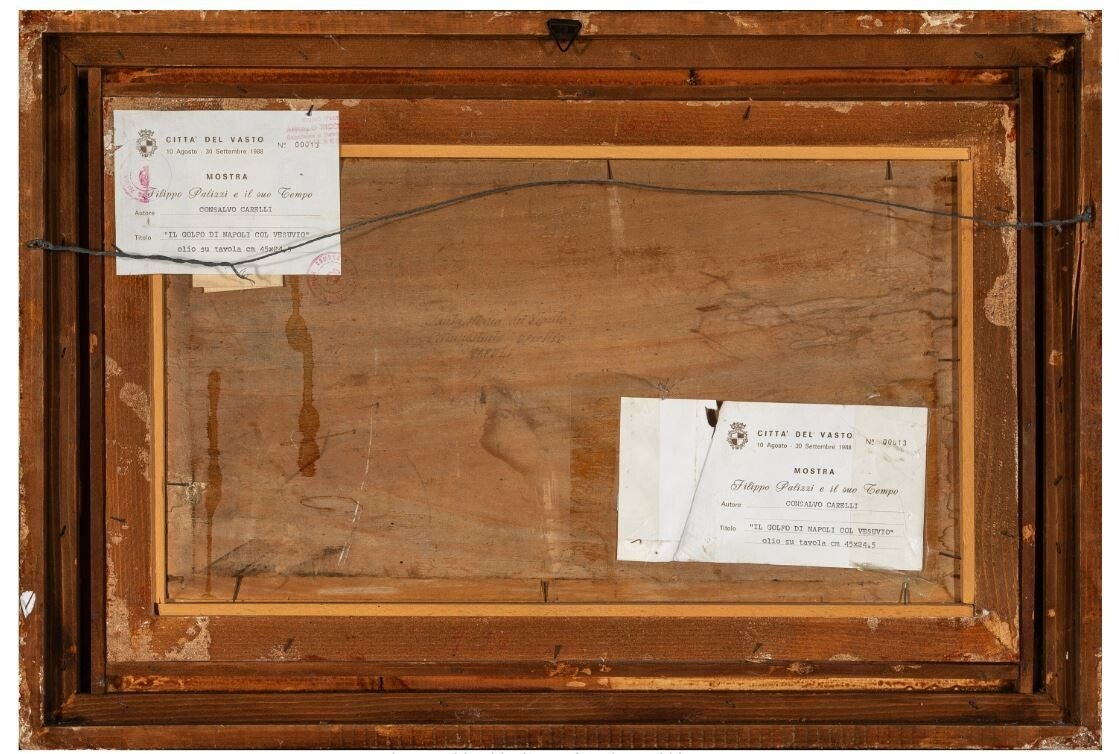
The exhibition history of the work is documented by the material preserved on the reverse of the support, which bears the original exhibition label for «Filippo Palizzi e il suo Tempo», held at Palazzo D'Avalos in Vasto in 1988 under the curatorship of Angelo Ricciardi. The painting is reproduced as number 13 in the official exhibition catalogue and carries the stamp of the Studio d'Arte Ricciardi.