

Consalvo Carelli (Naples, 1818 – Naples, 1900)
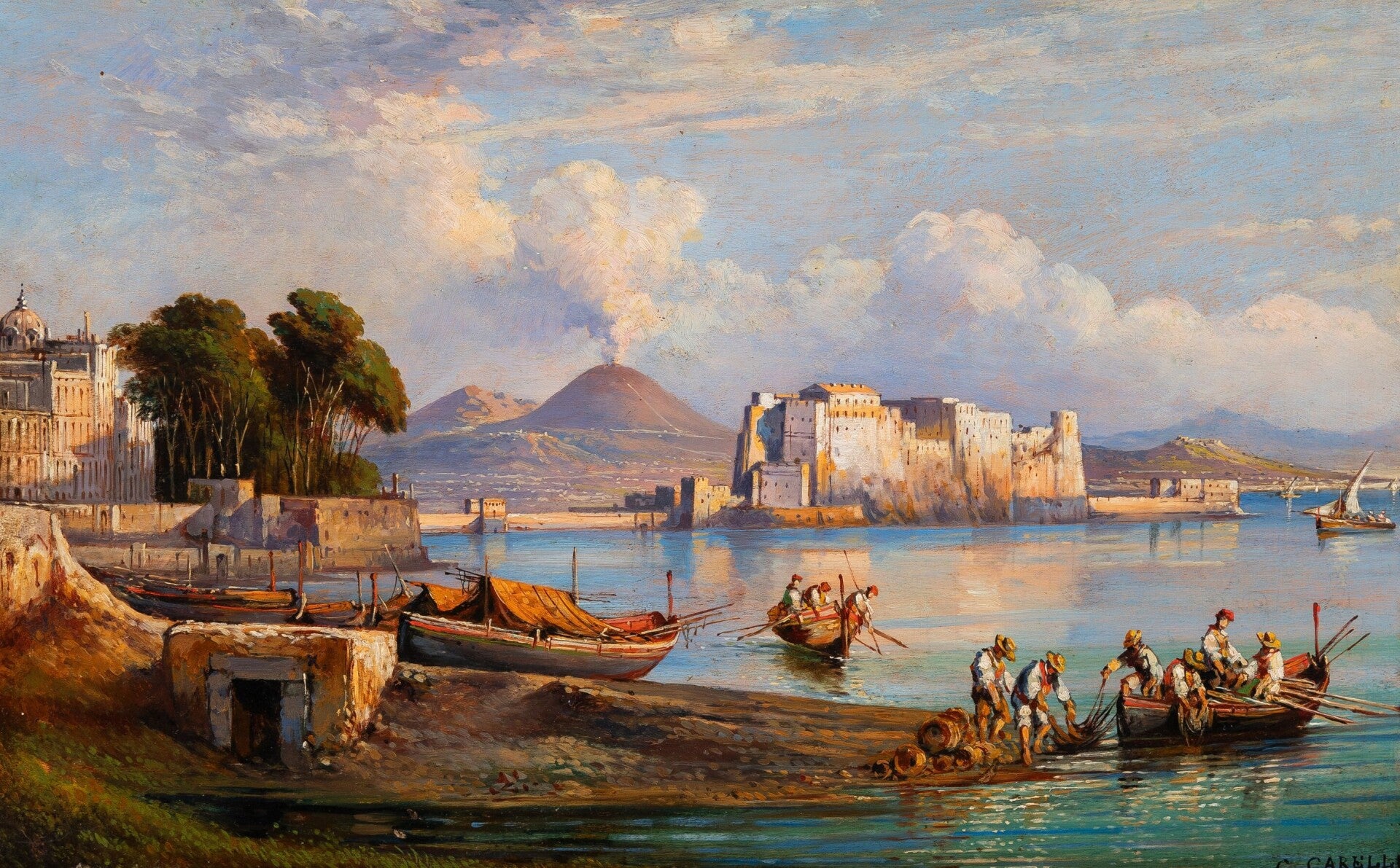
“Mattino sulla spiaggia di Chiatamone: pescatori luciani tra il Castel dell’Ovo, il Vesuvio e il Casino Reale”
(“Morning on the Beach of Chiatamone: Luciani Fishermen Between Castel dell'Ovo, Mount Vesuvius, and the Royal Casino”)
1845/1850
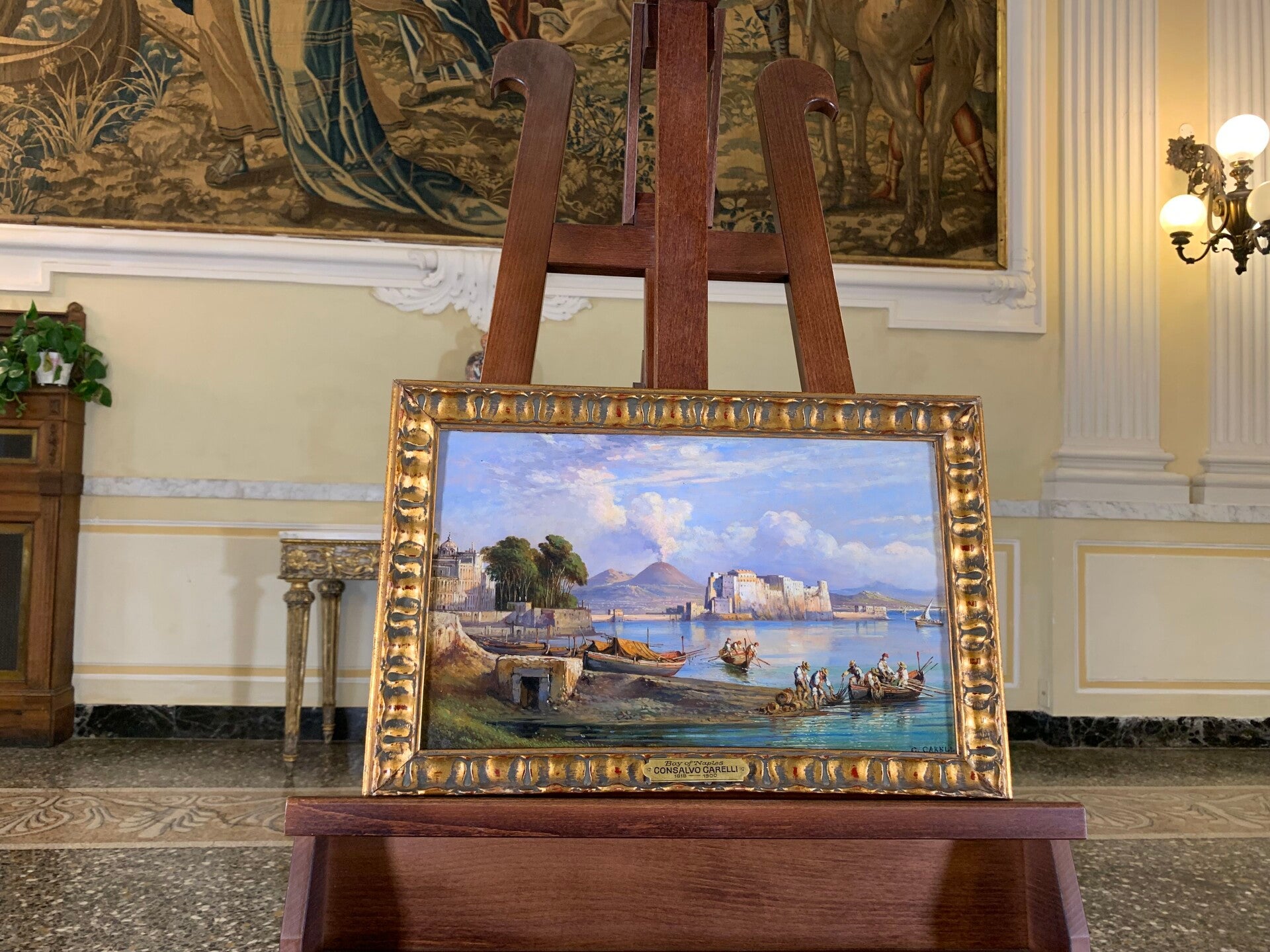
Oil on panel – 25 × 40 cm
Signed lower right
This panel stands among the most balanced achievements of nineteenth-century Italian landscape painting, fully asserting its place within the tradition of the School of Posillipo. Founded in the first half of the nineteenth century through the initiative of masters such as Anton Sminck van Pitloo and Giacinto Gigante, this fundamental movement dismantled the rigid tenets of official academicism, introducing en plein air painting and a renewed sensitivity to the atmospheric and luministic values of the Neapolitan landscape. It was within this vibrant cultural context that Consalvo Carelli forged his artistic identity; bolstered by his early training in the studio of his father Raffaele and his subsequent study sojourns in Rome and Paris—culminating in the award of a gold medal at the Salon of 1842 and major commissions for the French court—Carelli attained his full expressive maturity precisely between 1845 and 1850.
In Morning on the Beach at Chiatamone, Carelli exemplarily synthesizes the constructive rigor of classical draughtsmanship with an extraordinary sensitivity to the rendering of Mediterranean light. The work serves as a visual translation of the poetics of the "idealized true" («vero idealizzato»), a concept theoreticalized by the painter himself in his writings: an approach that rejected the mere mechanical or photographic replication of reality with its imperfections, seeking instead to bring natural observation to a measure of ideal harmony and perfection through the filter of intellectual refinement. From a strictly technical standpoint, the fluidity of the brushwork and the clarity of the palette—gradating from the emerald tones of the foreshore to the deep azure of the gulf—are the result of the rigorous use of exceptionally pure oil binders, free of bitumen or discolouring additives, ensuring the flawless preservation and chromatic stability that the work still displays today.
Beyond its high pictorial merit, the painting stands as a historical and topographical document of extraordinary interest, capturing the appearance of the Neapolitan coastline prior to the profound urban developments following the Unification of Italy and the late nineteenth-century Risanamento. At the center of the composition, the profile of the Castel dell’Ovo stands out prominently, still encircled by the sea and connected to the mainland solely by a stone isthmus. In the background, Mount Vesuvius defines the horizon with a moderate plume of smoke, adhering strictly to scientific records of volcanic activity during the 1845–1850 period. To the left, partially shaded by coastal vegetation, one recognizes the Casino Reale di Chiatamone, a Bourbon residence and diplomatic guest house—whose notable visitors included Giacomo Casanova—later granted by Garibaldi to Alexandre Dumas père before being definitively demolished in the second half of the century.
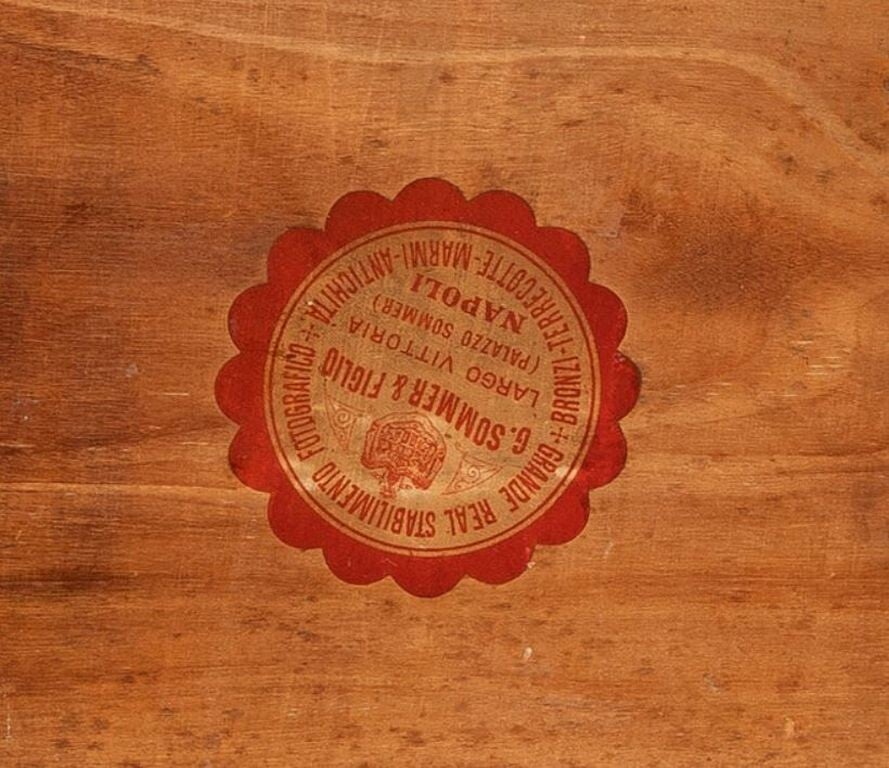
The element of greatest narrative dynamism is entrusted, in the foreground, to the figures of the luciani fishermen, the historical inhabitants of the Santa Lucia quarter, depicted with acute precision in their daily working lives among boats, nets, and baskets. Carelli never lapses into anecdotal folklorism or sentimentality, but instead elevates working-class life into a subject of autonomous aesthetic dignity. Confirming the work’s distinguished collecting history through mid-nineteenth-century Neapolitan market channels, the reverse of the panel retains the original stamp of the renowned art house and photographic establishment "G. Sommer & Figlio" of Largo Vittoria. The painting thus presents itself not only as a fine example of Consalvo Carelli’s vedutismo, but as a collecting opportunity of rare merit, formally and historically documented.