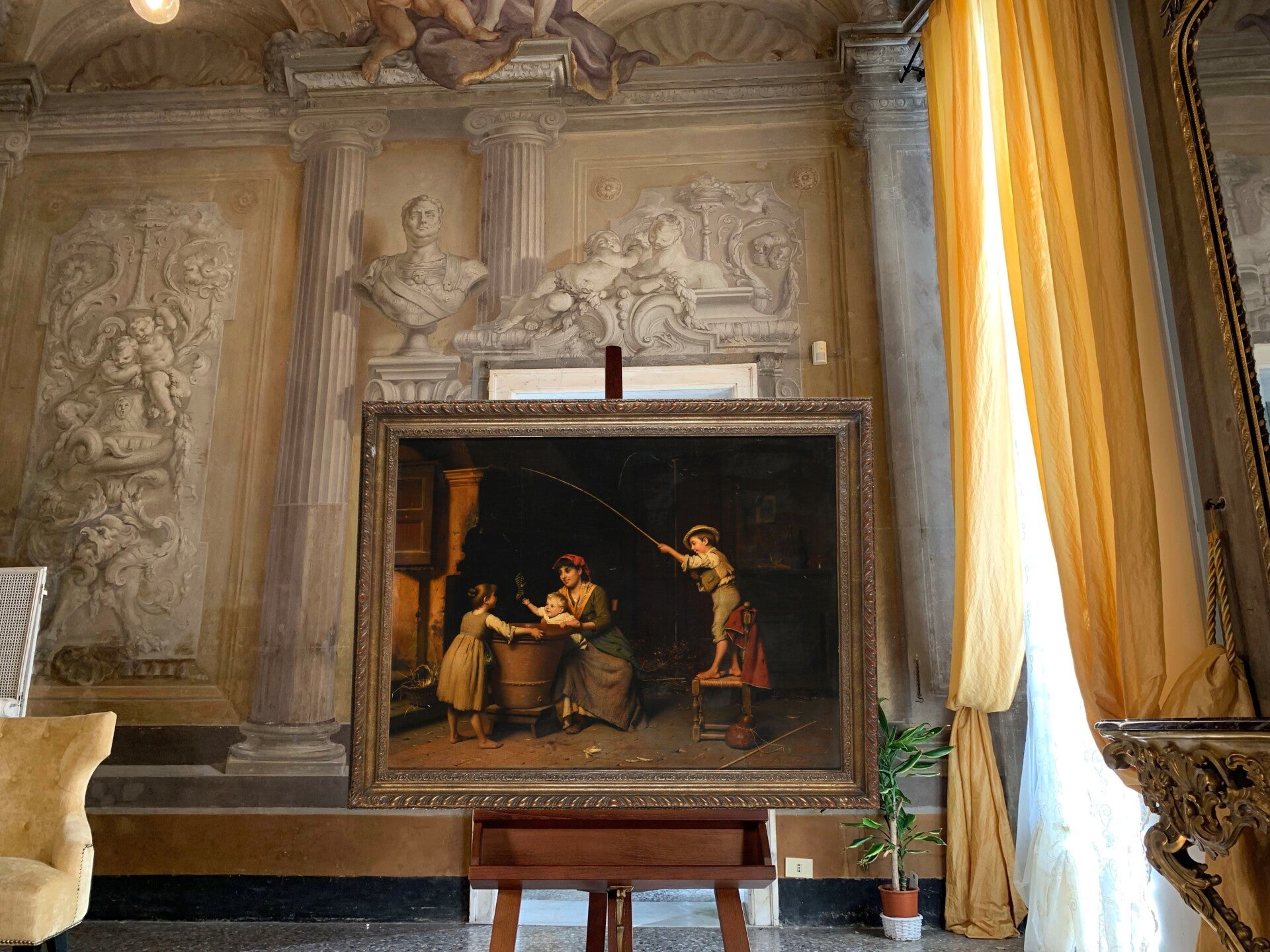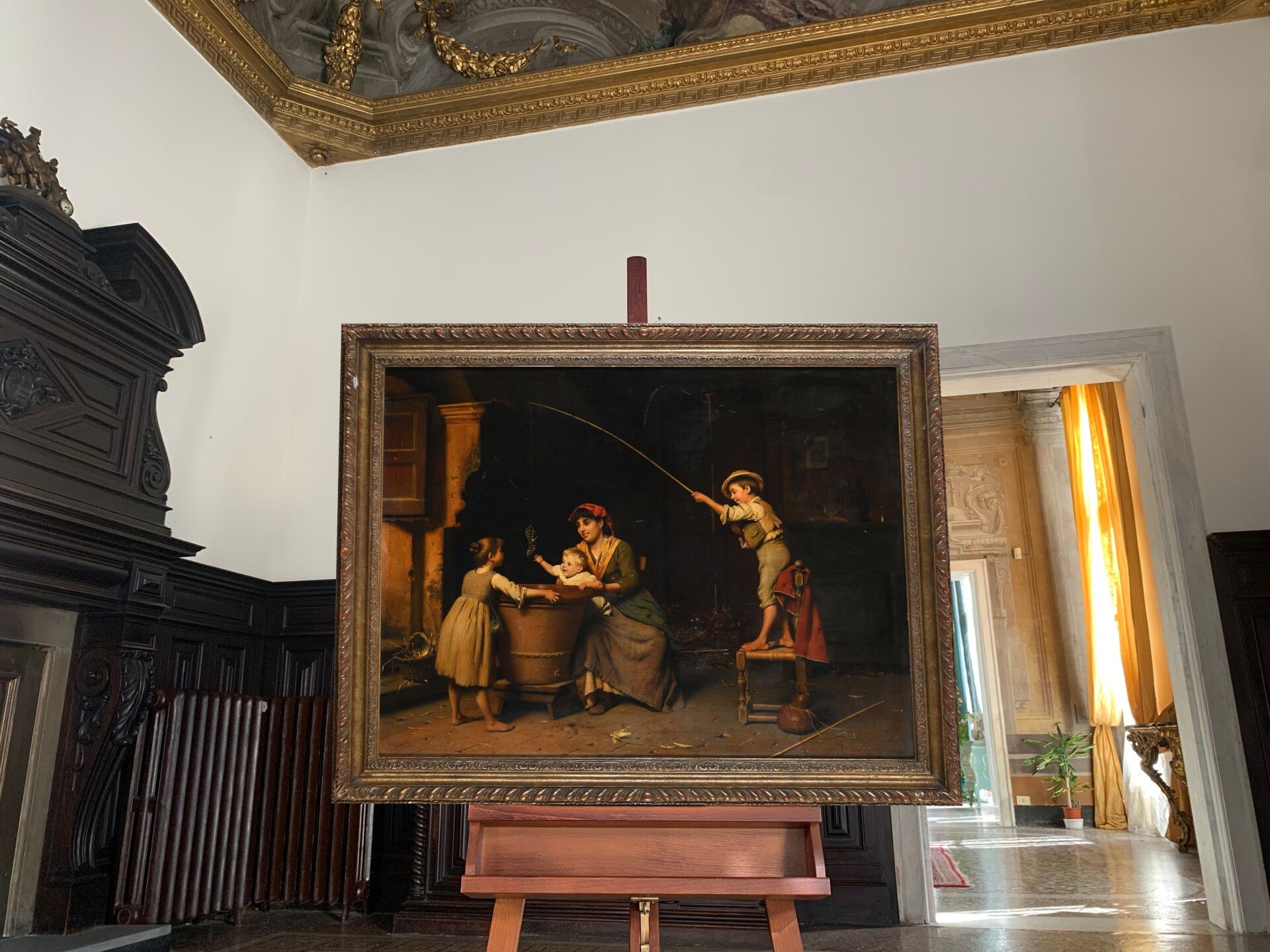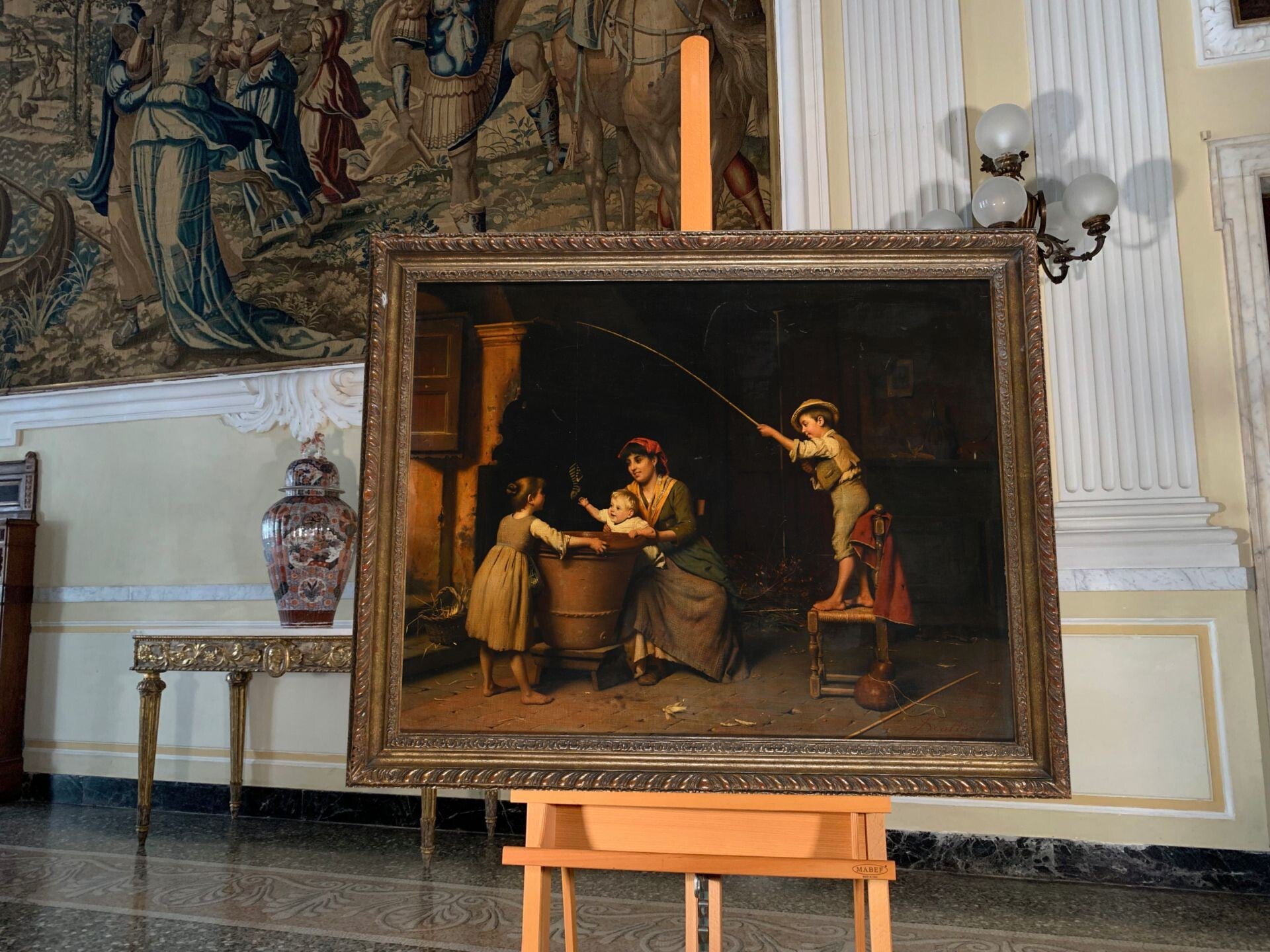

Luigi Scaffai (Livorno, 18 August 1837 – 1899)
“Fishing”
Oil on canvas - 65 x 86 cm
Signed lower right
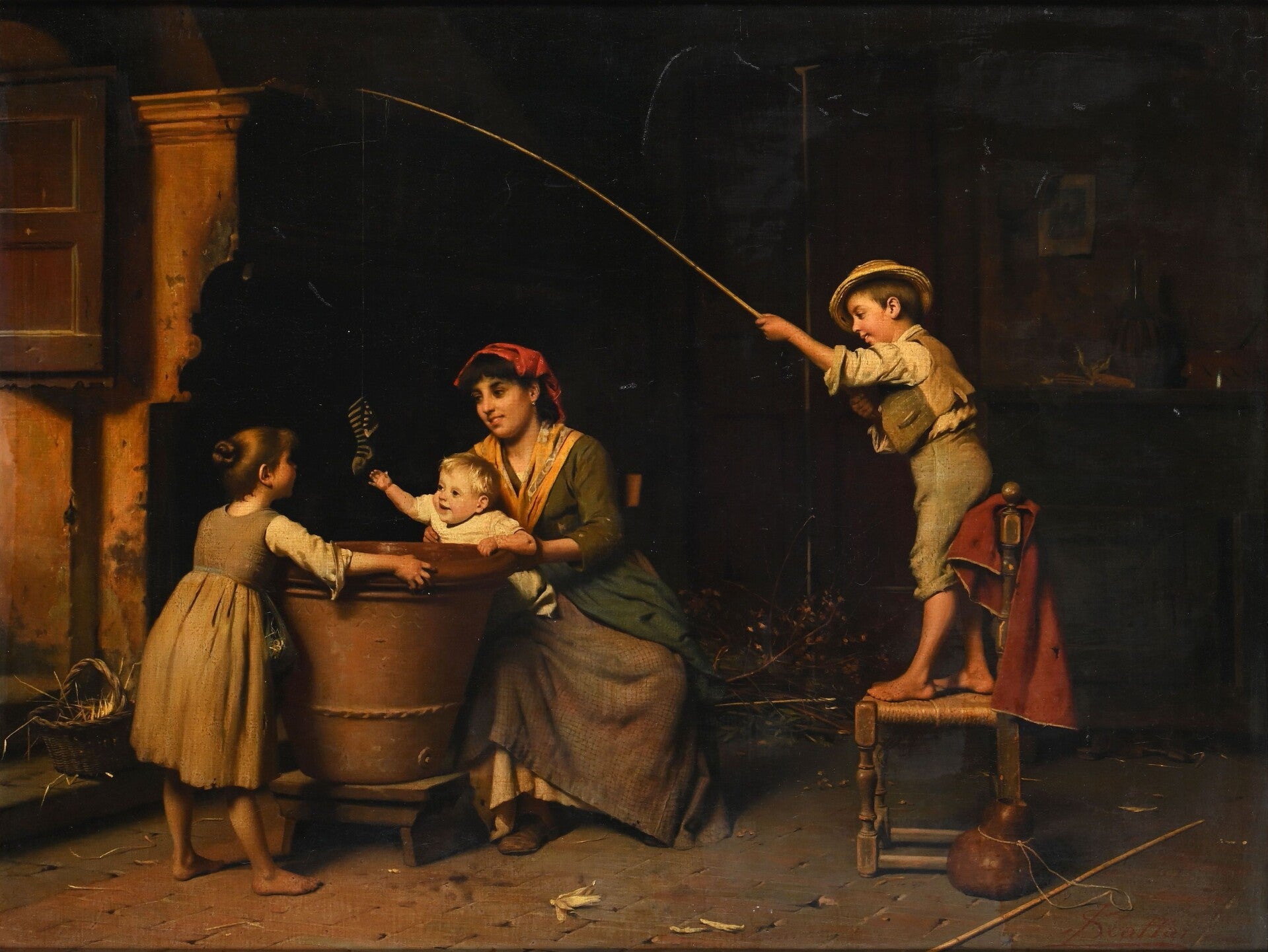
An intimate childhood game set in the quiet of a rustic kitchen animates La Pesca (Fishing, oil on canvas, 65 x 86 cm), a painting in which Luigi Scaffai offers a testament to expressive maturity and remarkable narrative sensitivity. Trained at the Academy of Fine Arts in Florence, the Livorno-born artist directed the rigor of Tuscan draftsmanship toward the poetics of "affective verismo" (verismo affettivo), a movement dedicated to investigating domestic intimacy and the simplicity of rural life with lenticular precision. The scene unfolds within an austere peasant interior, dominated by an extinguished hearth and a shadowed wall that serve as a theatrical backdrop for a poetic children's game. At the center of the composition, a young boy balancing on a rush-bottomed chair holds a rudimentary fishing rod with a stocking attached as bait, "fishing" inside a large terracotta jar. The emotional focal point is formed by the mother supporting an infant who reaches toward the bait, while a third young girl looks on. The artist's technical mastery is revealed in the skillful orchestration of side lighting, which creates a rigorous chiaroscuro and illuminates a palette woven with warm earthy tones, ochres, and browns.
Scaffai's talent, recognized early on by contemporary critics—as evidenced by the acclaim received at the 1869 Turin Exhibition for his canvas depicting Leonardo da Vinci—found its ideal domain in the observation of childhood and familial values. His works, aimed at encapsulating the dignity and candor of the Italian countryside, became the object of sustained interest from a refined international clientele, particularly Anglo-Saxon and American collectors. This private success was accompanied by major institutional accolades: notably, in 1881, King Umberto I purchased the painting Il piccolo fumatore (The Little Smoker), designating it for the royal collections at Palazzo Pitti (today part of the holdings of the Galleria d'Arte Moderna in Florence), confirming the artist's definitive entry into the official and collecting circuits of the Kingdom.
Enhancing the historical and critical prestige of La Pesca is its distinguished provenance, documented at the Galleria Pisani in Florence. Founded by the celebrated art dealer Luigi Pisani within the fifteenth-century Palazzo Lenzi in Piazza Ognissanti, this institution represented a crucial hub for the post-Unification art market, acting as a magnet for the major European collectors. Within the gallery's rooms, Scaffai exhibited alongside the greatest masters of the Macchiaioli movement—such as Giovanni Fattori, Silvestro Lega, and Telemaco Signorini—as well as artists of national stature like Lorenzo Delleani and Guglielmo Ciardi. The selection of the work by Pisani guaranteed a high standard of quality, positioning the painting within the most prestigious collecting channels of the era (noting, moreover, that upon the gallery's closure in 1914, part of the Pisani collection was acquired by the Galleria d'Arte Moderna in Rome).
The broad aesthetic favor enjoyed by the work among contemporary audiences is confirmed by its widespread visual success. La Pesca was selected by the firm Fratelli Alinari for inclusion in its official art reproduction catalogues (under inventory number 16621), enjoying extensive international photographic circulation. The image subsequently transcended the boundaries of specialized printing to enter popular publishing through the release of numerous series of hand-colored and chromolithographic illustrated postcards. Through this dual existence—from elite easel display to mass dissemination—Luigi Scaffai's canvas captures the nineteenth-century domestic ideal, marrying academic formal rigor with the immediate authenticity of popular sentiment.
A note on the care of this painting:
The work, which today appears enveloped in the warm and evocative patina of time, is currently undergoing a scheduled conservative cleaning. This is a meticulous and respectful treatment designed to remove old protective varnishes aged by time, thereby restoring full breath to the natural luminosity of Luigi Scaffai's colors.
The restoration will be completed in September, at which time new photographs of the painting will be published. In the meantime, the work remains available for further inquiry, contemplation, and, should one wish, reservation, before resuming its journey toward the collector who will welcome it.